Touchline
An agentic AI coaching platform built for grassroots football. Purpose-built, parent-controlled, and fully logged, so volunteer coaches can run better sessions in less time without ever putting a child in front of a general-purpose chatbot.
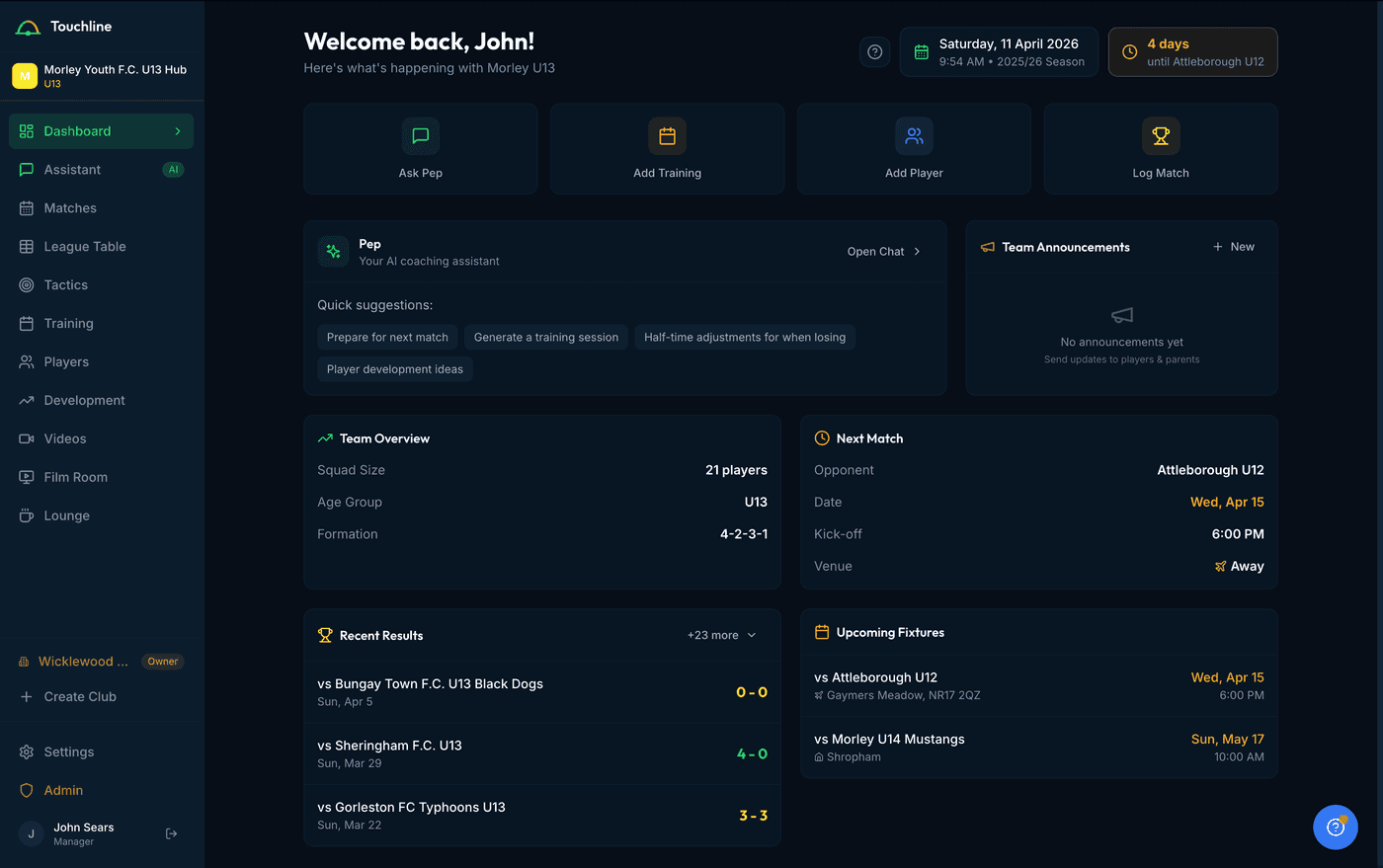
The Touchline coaching dashboard. Session planning, player development, and club management in one place.
Volunteer coaches are running professional clubs in their spare time.
Grassroots football in the UK is held together by volunteers. A typical club has dozens of teams, hundreds of players, and a coaching staff made up almost entirely of parents who took the badge because nobody else would. They are expected to plan age-appropriate sessions, manage player development, communicate with parents, handle safeguarding, and turn up on a Saturday morning ready to teach. Most of them have a full-time job and a family on top of all of that.
The tools available to them have not kept up. Session libraries are static. Player tracking lives in a spreadsheet, if it exists at all. Communication happens in WhatsApp groups that nobody can search. And the obvious shortcut, dropping a question into a general-purpose chatbot, is not safe to put in front of children and is not something any responsible club can recommend.
Touchline was founded to close that gap. The brief was to build a coaching assistant that saves time, raises the quality of what happens on the training pitch, and is safe enough that a club can deploy it across every age group without a safeguarding officer losing sleep.
Bounded AI as a first principle, not a feature.
How we keep AI accountable, scoped, and safe to put in front of children and vulnerable users.
The first decision shaped every decision that followed. Touchline does not wrap a general-purpose chatbot in a football skin. It is custom-trained on grassroots coaching content, purpose-built for the specific jobs a coach actually does, fully logged so every interaction is auditable, and parent-controlled so families decide what their child can see and do. That is what bounded AI means in practice, and it is the single biggest reason clubs trust the platform.
The architecture refuses inputs that are off-scope at the perimeter, runs scoped specialist tools inside a controlled boundary, and writes every interaction to an audit log. No untrusted prompts. No off-task drift. No direct child contact with a general model. The boundary is the product.
Hierarchical multi-agent architecture
Under the hood, Touchline uses a supervisor agent that routes each request to a specialist sub-agent with a tight set of tools. One specialist handles session planning. Another handles player development notes. Another handles parent communication. Each one does a small number of things well, rather than one giant agent doing everything badly. This pattern is faster, cheaper to run, easier to debug, and produces noticeably better answers than the single-agent-many-tools approach most products default to.
Built for the way coaches actually work
Touchline is a progressive web app, which means a coach can install it on their phone in seconds without going through an app store gatekeeper, and use it on the touchline with one hand while holding a clipboard in the other. Sessions can be planned in a five-minute walk from the car park to the pitch. Player notes can be dictated on the drive home. Parent updates can be drafted in the time it takes to make a cup of tea.
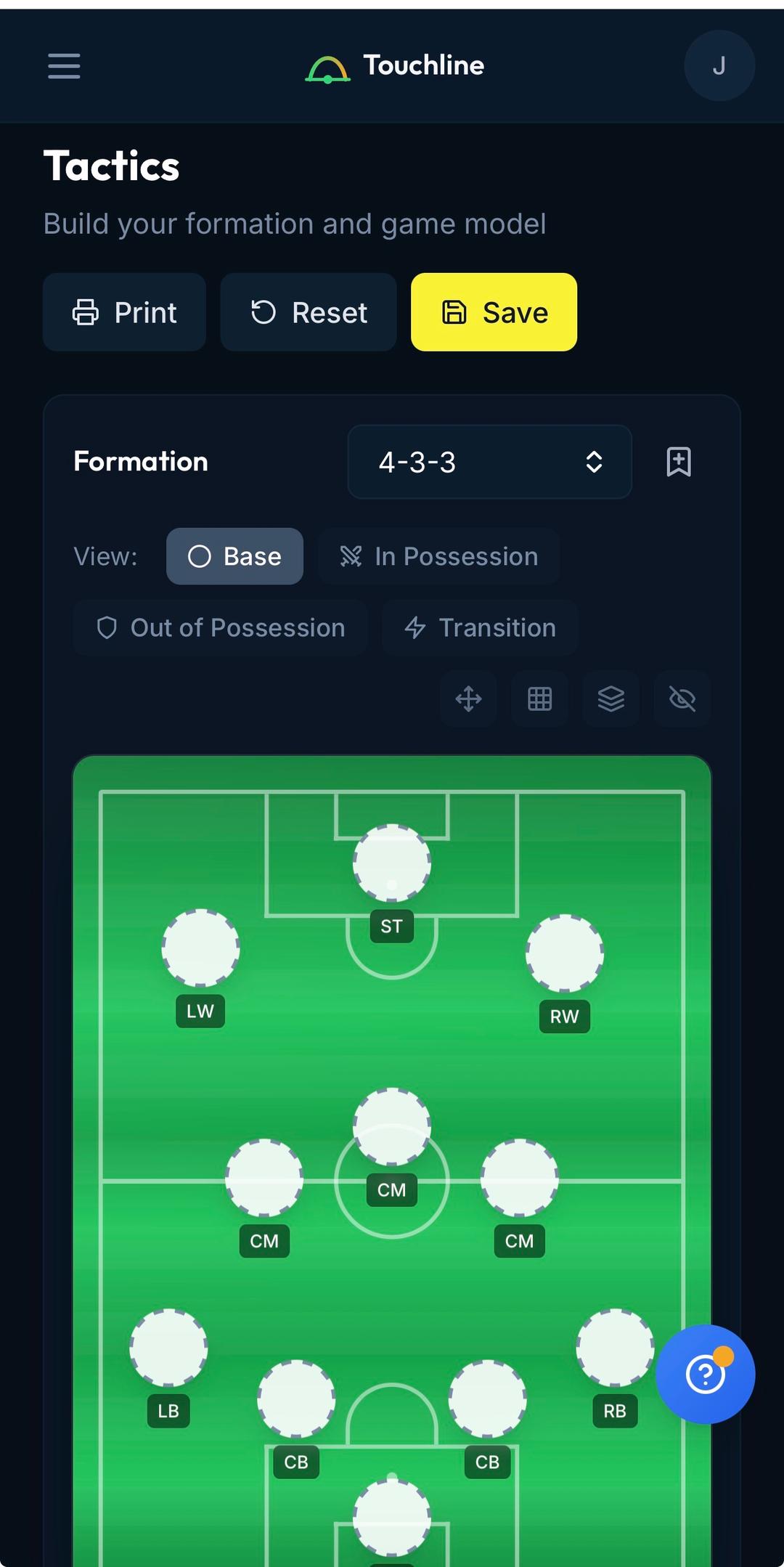
Designed to scale from one coach to a whole club
The platform works for a single volunteer with one team and for a 22-team charter standard club with a chairman who needs oversight across the lot. Club administrators get a dashboard. Coaches get their own workspace. Parents get a controlled view of what their child is doing. All on the same platform, all built from the same multi-agent foundation.
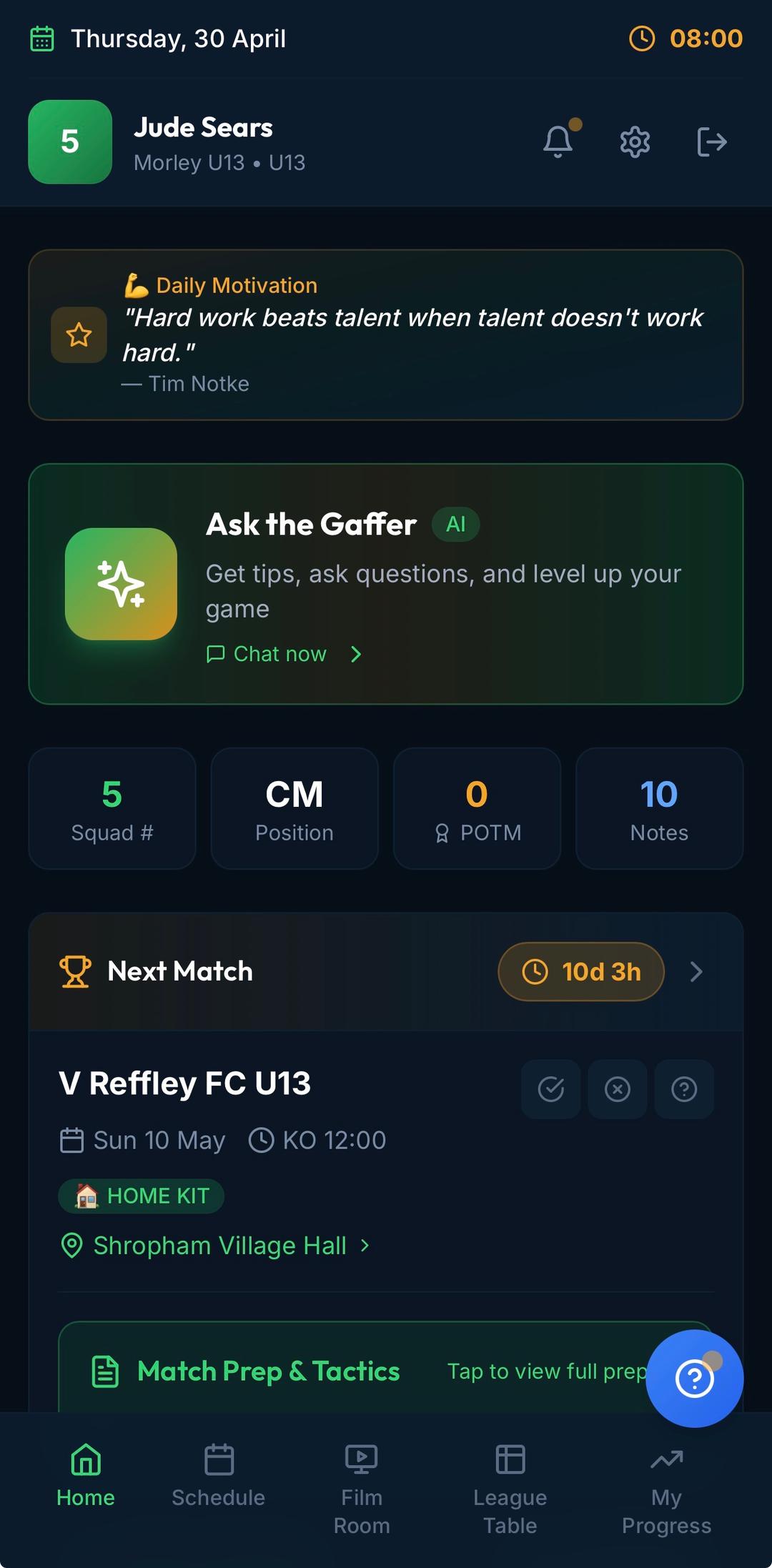
Coaches save hours every week and the quality of sessions goes up.
The clearest signal from early users is the same one every time. Session planning that used to take an hour takes ten minutes. Player notes that used to live in a coach’s head now live in a searchable record the whole club can build on. Parent communication that used to be a Sunday night chore is drafted in seconds and sent in two taps.
The quality improvement is harder to measure but just as real. Coaches who were guessing at age-appropriate drills now have a knowledgeable assistant that actually understands the FA’s syllabus and the player’s developmental stage. Clubs that had no consistent coaching standard across teams now have one, because every coach is drawing on the same well-trained foundation.
And because every interaction is logged and bounded, the safeguarding conversation with parents is short. Families can see exactly what the platform can and cannot do, and they decide what their child engages with. Nobody is asking a chatbot whether it is safe for children, because it was never a chatbot in the first place.
“The lesson from Touchline is that you do not solve a real-world problem by bolting AI onto it. You solve it by deciding, before you write a line of code, what the AI is allowed to do, who it is accountable to, and which jobs it will refuse. Bounded AI is harder to build than a wrapper around a chatbot, but it is the only kind of AI you can responsibly put in front of a volunteer coach and a child. That principle is portable. Whatever industry you are in, if your users include people who deserve protection, this is the pattern you need.”
Touchline.xyz is the clearest example of what MoonBoots Consultancy builds: agentic systems that are purpose-built rather than prompt-engineered, hierarchical rather than monolithic, and bounded rather than open-ended. If you have a problem that touches children, vulnerable users, regulated data, or any setting where a generic chatbot is the wrong answer, we have already solved a harder version of it.
Services used in this project
Most engagements start with a conversation.
Tell me what you’re working on and I’ll suggest the clearest path forward. No obligation, no hard sell. Prefer the phone? 07917 834 059.